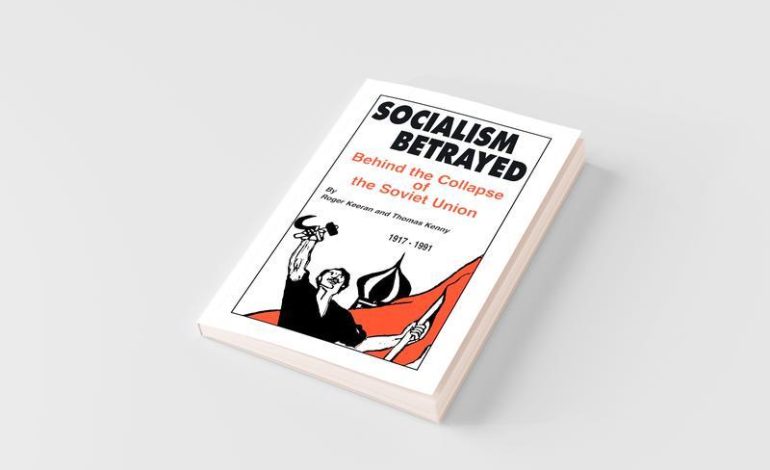
வஞ்சகத்தால் வீழ்த்தப்பட்ட சோசலிசம் book Reference

Notes for Introduction
1. **Anthony D’Agostino**, *Gorbachev’s Revolution* (New York: New York University Press, 1998), 9. [1]
2. **Alexander Dallin**, “The Causes of the Collapse of the Soviet Union,” *Post-Soviet Affairs*, Vol. 8, No. 4 (1992), 279. [1]
3. **Fidel Castro** quoted by **Andrew Murray**, *Flashpoint: World War III* (London: Pluto Press, 1996), 38. [1]
4. **Victor and Ellen Perlo**, *Dynamic Stability: The Soviet Economy Today* (Moscow: Progress Publishers, 1980), passim; *USSR: 100 Questions and Answers* (Moscow: Novosti, 1977), 60, 63; **Albert Szymanski**, *Class Structure: A Critical Perspective* (New York: Praeger, 1983), 590. [1]
5. **Perlo**, 144; *USSR: 100 Questions and Answers*, 65-66, 71. [1]
6. **Szymanski**, 586-592. [1]
7. **Karl Marx**, “The Civil War in France” and **Frederick Engels**, “Introduction,” in Karl Marx and Frederick Engels *Selected Works in Two Volumes* (Moscow: Foreign Languages Publishing House, 1962), 473-545. [2]
8. **Edward Boorstein**, *Allende’s Chile* (New York: International Publishers, 1977). [2]
9. **Edward Hallett Carr**, *What Is History?* (New York: Vintage Books, 1967), 125-127. [2]
10. **Eric Hobsbawm**, *On History* (New York: The New Press, 1997), 243-249. [2]
11. **Omar Noman**, ed. *Poverty in Transition* (New York: United Nations Development Program, 1998), 6. [2]
12. **Stephen Cohen**, *Failed Crusade* (New York and London: W. W. Norton, 2000), 40-42. [2]
13. **Marx and Engels**, 485, 542. [2]
### **Notes for Chapter 2**
14. **Dmitri Volkogonov**, *Stalin: Triumph and Tragedy* (New York: Grove Weidenfeld, 1988), 80. [2]
15. **Albert Resis**, ed., *Molotov Remembers: Inside Kremlin Politics* (Chicago: Ivan R. Dee, 1993), 360. [2]
16. **Resis**, 408. [2]
17. “Socialism in the Soviet Union: Lesson and Perspectives, From the Program of the Fourth Congress of the Communist Party of the Russian Federation 20 April 1997,” *Nature, Society, and Thought* (May 2, 2000), 421. [2]
18. *Lenin Collected Works*, ed. Yuri Sdobnikov, vol. 32 (Moscow: Progress Publishers, 1975), 165-240. [2]
19. *Lenin Collected Works*, vol. 33, 63. [2]
20. *Lenin Collected Works*, vol. 32, 218. [2]
21. *Vladimir I. Lenin: A Political Biography* (New York: International Publishers, 1943), 242-259. [2]
22. **Barrington Moore, Jr.**, *Soviet Politics–The Dilemma of Power* (Cambridge: Harvard University Press, 1951), 98-102. [2]
23. **Moore**, 102-108. [2]
24. **Anatoly Chernyaev**, *My Six Years with Gorbachev* (University Park: Pennsylvania State University Press, 2000), 138-139. [3]
25. **Kenneth Cameron**, *Stalin: Man of Contradiction* (Toronto: New Canada Publications, 1987), 30. [3]
26. **Moore**, 108-113. [3]
27. **E. H. Carr**, *Studies in Revolution* (New York: Grosset & Dunlap, 1964), 214-215. [4]
28. **Joseph Stalin**, “The Right Deviation in the Communist Party of the Soviet Union,” in Joseph Stalin, *Leninism: Selected Writings* (New York: International Publishers, 1942), 98-101. [4]
29. **George Katkov**, *The Trial of Bukharin* (New York: Stein and Day, 1969), 55-60. [4]
30. **V. Y. Zevin**, “Lenin on the National and Colonial Questions,” in *Lenin the Great Theoretician* (Moscow: Progress Publishers, 1970), 307-308. [4]
31. **V. Zotov**, *Lenin’s Doctrine of National Liberation Revolutions and the Modern World* (Moscow: Progress Publishers, 1983), 15, 21. [4]
32. **Joseph Stalin**, *Marxism and the National and Colonial Question* (New York: International Publishers, 1934). [4]
33. **Albert Nenarokov** and **Alexander Proskurin**, *How the Soviet Union Solved the Nationalities Question* (Moscow: Novosti Press, 1983), 11. [4]
34. **Stephen Cohen**, *Bukharin and the Bolshevik Revolution* (New York: Knopf, 1973), 35-38. [4]
35. **Stalin**, 185, 177, 168-170. [4]
36. **Yitzhak M. Brudny**, *Reinventing Russia: Russian Nationalism and the Soviet State, 1953-1991* (Cambridge, Mass. and London: Harvard University Press, 1998), 42. [5]
37. **Bahman Azad**, *Heroic Struggle Bitter Defeat* (New York: International Publishers, 2000), 92-95. [5]
38. **Leonard Shapiro**, *The Communist Party of the Soviet Union* (New York: Vintage Books, 1971), 515. [5]
39. **Werner G. Hahn**, *Postwar Soviet Politics: The Fall of Zhdanov and the Defeat of Moderation, 1946-1953* (Ithaca and London: Cornell University Press, 1982), 12-13, 19-27. [5]
40. **Hahn**, 32-33, 45-57, 182-184. [5]
41. **William Taubman**, *Khrushchev: The Man and His Era* (New York and London: W. W. Norton, 2003), 250-255. [6]
42. **Roy A. Medvedev** and **Zhores Medvedev**, *Khrushchev: The Years in Power* (New York: W. W. Norton, 1978), 67-71. [6]
43. **Medvedev and Medvedev**, 71. [6]
44. **Taubman**, 324. [6]
45. **Carl Linden**, *Khrushchev and the Soviet Leadership* (Baltimore and London: Johns Hopkins University Press, 1990), 224. [6]
46. **Hahn**, 47. [6]
47. **Roy Medvedev**, *Khrushchev* (London and New York: Blackwell and Doubleday, 1982), 32. [7]
48. **Medvedev and Medvedev**, 35, 58-60. [7]
49. **Maurice Dobb**, *Soviet Economic Development Since 1917* (New York: New World Paperbacks, 1965), 317, 332. [7]
50. **Joseph Stalin**, *Economic Problems of the U.S.S.R.* (New York: International Publishers, 1952), 21-22. [7]
51. **Hans Heinz Holz**, “The Downfall and Future of Socialism,” *Nature, Society, and Thought*, 5, no. 3 (1992), passim. [7]
52. **Holz**, 105. [8]
53. **Holz**, 105. [8]
54. **Resis**, 391. [8]
55. **Giuseppe Boffa**, *Inside the Khrushchev Era* (New York: Marzani and Munsell, 1959), 108. [8]
56. **Boffa**, 110. [8]
57. **Medvedev and Medvedev**, 75. [8]
58. **Alexei Adzhubei** quoted by **Linden**, 225. [8]
59. **Roger Pethybridge**, *A Key to Soviet Politics: The Crisis of the ‘Anti-Party’ Group* (London: George Allen & Unwin, 1962), 93-98. [8]
60. **Resis**, 345-347; **Molotov** and **Malenkov** quoted by **Pethybridge**, 98-99. [8]
61. **Pethybridge**, 95, 103-109; **Shapiro**, 569. [8]
62. **Taubman**, xix. [8]
63. **Cameron**, 130. [8]
64. **Michael Parenti**, *Blackshirts & Reds* (San Francisco: City Lights Books, 1997), 76-80. [8]
65. “Secret Speech of Khrushchev Concerning the ‘Cult of the Individual,’” in *The Anti-Stalin Campaign and International Communism* (New York: Columbia University Press, 1956), 2-89; **Cameron**, 121-137, 170. [8]
66. **Yegor Ligachev**, *Inside Gorbachev’s Kremlin* (New York, Pantheon, 1993), 284. [9]
67. **Cameron**, 123. [9]
68. **Gerald Meyer**, “The Virgin Lands Project, 1953-1963: Khrushchev’s Panacea for the Soviet Union’s Agricultural Crisis,” (M.A. thesis, City College of the City University of New York, 1969). [9]
69. **Meyer**, 35-37. [9]
70. **Stalin**, 16-17. [9]
71. **Medvedev and Medvedev**, 85-88. [9]
72. **Dobb**, 372-377. [9]
73. **Alex Nove**, *An Economic History of the USSR* (New York: Viking Penguin, 1984), 358. [9]
74. **Medvedev and Medvedev**, 106-107. [9]
75. **Dobb**, 321, 324. [9]
76. **Dobb**, 329-330. [9]
77. **J. P. Nettl**, *The Soviet Achievement* (Norwich, England: Harcourt, Brace & World, 1967), 236. [10]
78. **Brudny**, 42-43. [10]
79. **Medvedev and Medvedev**, 73, 148. [10]
80. **Medvedev and Medvedev**, 43. [10]
81. *A Proposal Concerning the General Line of the International Communist Movement* (Peking: Foreign Language Press, 1963), 5-36. [11]
82. **Joseph Stalin**, *For Peaceful Coexistence: Postwar Interviews* (New York: International Publishers, 1951). [11]
83. **O.B. Borisov** and **B. T. Koloskov**, *Sino-Soviet Relations* (Moscow: Progress Publishers, 1975), 173. [11]
84. **Taubman**, 336-337, 450-451, 609-610; **Kirby** quoted by **Taubman**, 337. [11]
85. **Shapiro**, 575. [11]
86. **Linden**, 224. [11]
87. **Azad**, 128-131. [11]
88. **George Breslauer**, “Khrushchev Reconsidered,” in Stephen F. Cohen et al., eds., *The Soviet Union Since Stalin* (Bloomington: Indiana University Press, 1980), 56, 59. [11]
89. **Medvedev and Medvedev**, 151, 153. [11]
90. **John Gooding**, *Socialism in Russia: Lenin and his Legacy, 1890-1991* (New York: Palgrave, 2002), 187-209. [11]
91. **Dmitri Volkogonov**, *Autopsy for an Empire* (New York, London, Toronto, Sydney, Singapore: The Free Press, 1998), 262, 264, 302, 320, 324; **Peter Kenez**, *A History of the Soviet Union from the Beginning to the End* (Cambridge, UK: Cambridge University Press, 1999), 215, 217; **Roy Medvedev**, “Brezhnev: a Political Sketch-Portrait,” in *Leonid Brezhnev: The Period of Stagnation* (Moscow: Novosti Press, 1989), 6, 9. [11]
92. *Pravda* quoted by **Breslauer**, 64. [12]
93. **Fedor Burlatsky**, “Brezhnev and the End of the Thaw,” in *Leonid Brezhnev: The Period of Stagnation*, 38. [12]
94. **Stephen F. Cohen** and **Katrina vanden Heuvel**, *Voices of Glasnost* (New York: W. W. Norton, 1989), 20. [12]
95. **Victor and Ellen Perlo**, *Dynamic Stability: The Soviet Economy Today* (Moscow: Progress Publishers, 1980), 331. [12]
96. **Abel Aganbegyan**, *The Economic Challenge of Perestroika* (Bloomington and Indianapolis: Indiana University Press, 1988), 45, 52-53, 90. [12]
97. **Victor and Ellen Perlo**, 275. [12]
98. **Victor Perlo**, *Super Profits and Crises: Modern U.S. Capitalism* (New York: International Publishers, 1988), 491. [12]
99. **Aganbegyan**, *The Economic Challenge of Perestroika*, 3, 23, 67, 71. [12]
100. **Leonid Brezhnev**, *We Are Optimists: Report of the Central Committee of the Communist Party of the Soviet Union to the 26th Congress of the CPSU* (New York: International Publishers, 1981), 57. [12]
101. **Ligachev**, 211-212, 219. [12]
102. **Brudny**, 15-17. [13]
103. **Victor and Ellen Perlo**, 284. [13]
104. **Moshe Lewin**, *Political Undercurrents in Soviet Economic Debates* (Princeton, New Jersey: Princeton University Press, 1975), xiii. [13]
105. **Anders Aslund**, *Gorbachev’s Struggle for Economic Reform* (Ithaca, New York: Cornell University Press, 1989), ix, 4. [13]
106. **Perlo**, 260-280. [13]
107. **Perlo**, 260-280. [13]
108. **Perlo**, 282, 284. [13]
109. **Zhores Medvedev**, *Andropov* (New York and London: W. W. Norton, 1983), 17-54; **Martin Ebon**, *The Andropov File* (New York et al.: McGraw-Hill, 1983), 272-273. [14]
110. **Ebon**, 17-22, 70-71, 86-92, 109. [14]
111. **Ebon**, 64-74; **Zhores Medvedev**, 32-40; **Herbert Aptheker**, *The Truth About Hungary* (New York: Mainstream Publishers, 1957), 184-246. [14]
112. **Ebon**, 64-74; **Zhores Medvedev**, 32-40. [14]
113. **Ebon**, 70-71, 32, 24, 104; **Zhores Medvedev**, 32-40, 64-65. [14]
114. **Ebon**, 22, 24, 27, 29, 65. [14]
115. Quoted by **Zhores Medvedev**, 87. [14]
116. **Ligachev**, 27. [14]
117. **Zhores Medvedev**, 146; **Ebon**, 119. [14]
118. **Yuri Andropov**, “The Better We Work, the Better We Will Live” (November 22, 1982) in **Ebon**, 239-249; **Y. V. Andropov**, *Sixtieth Anniversary of the Union of Soviet Socialist Republics*, (December 21, 1982), (Moscow: Novosti, 1983); **Yuri Andropov**, *Analysis of the Existing Situation and Landmarks for the Future*, (June 15, 1983), (Moscow: Novosti, 1983); **Yuri Andropov**, “Karl Marx’s Teaching and Some of the Problems in the Building of Socialism in the USSR,” (1983) in *A Reader on Social Sciences* (Moscow: Progress, 1985), 395-419. [14]
119. **Martin Ebon**, *The Andropov File: The Life and Ideas of Yuri Andropov General Secretary of the Communist Party of the USSR* (New York, et al: McGraw-Hill Book Company, 1983), 239-249. [15]
120. **Andropov**, *Analysis*, 12. [15]
121. **Andropov**, *Analysis*, 17. [15]
122. **Andropov** in **Ebon**, 241. [15]
123. **Andropov** in **Ebon**, 241. [15]
124. **Andropov** in **Ebon**, 241. [15]
125. **Ebon**, 136-137. [15]
126. **Zhores Medvedev**, 134. [15]
127. **Medvedev**, 131-133. [15]
128. **Andropov**, “Karl Marx’s Teaching,” 407. [15]
129. **Ebon**, 186. [16]
130. **Ebon**, 173, 174, 193, 205, 208. [16]
131. **Andropov** in **Ebon**, 246. [16]
132. **Ebon**, 238. [16]
133. **Andrei Gromyko**, *Memoirs* (New York, et al.: Doubleday, 1989), 247. [16]
134. **Anatoly Dobrynin**, *In Confidence* (New York: Times Books/ Random House, 1995), 444. [16]
135. **Jonathan Harris**, *The Public Politics of Aleksandr Nikolaevich Yakovlev, 1983-1989*, The Carl Beck Papers in Russian and East European Studies, No. 901 (Pittsburgh: University of Pittsburgh Center for Russian and East European Studies, 1990), 12. [16]
136. **Andropov** quoted by **Dobrynin**, 512. [16]
137. **Ebon**, 234. [16]
138. **Dobrynin**, 478. [16]
139. **Ligachev**, 148. [16]
140. **Ebon**, 118. [16]
141. **Andropov**, *Analysis*, 18. [16]
142. **Ligachev**, 28. [16]
143. **Andropov**, *Analysis*. [16]
144. **Ebon**, 26. [16]
145. **Ebon**, 152, 201, 166, 168, 199. [16]
146. **Ebon**, 192, 203, 219, 230. [16]
147. **Andropov**, “Karl Marx’s Teaching,” 400-401. [16]
148. **Andropov**, *Sixtieth Anniversary*, 11-21. [16]
149. **Andropov**, *Sixtieth Anniversary*, 18. [16]
150. **Andropov**, *Sixtieth Anniversary*, 18-19. [16]
151. **Volkogonov**, 332, 370, 387. [16]
### **Notes for Chapter 3**
152. **Gregory Grossman**, “Subverted Sovereignty: Historical Role of the Soviet Underground,” in Stephen S. Cohen, et al., eds. *The Tunnel at the End of the Light* (Berkeley: University of California, 1988), 24-25. [17]
153. **Vladimir G. Treml** and **Michael Alexeev**, “The Growth of the Second Economy in the Soviet Union and Its Impact on the System,” in Robert W. Campbell, ed., *The Postcommunist Economic Transformation* (Boulder, San Francisco and Oxford: Westview Press, 1994), 222. [17]
154. Quoted by **Treml and Alexeev**, 238. [18]
155. **Moshe Lewin**, *Political Undercurrents in Soviet Economic Debates, from Bukharin to the Modern Reformers* (Princeton: Princeton University Press, 1975), 254. [18]
156. **Gregory Grossman**, “The ‘Second Economy’ of the USSR,” *Problems of Communism* (September-October, 1977), 25. [18]
157. **Maurice Dobb**, *Soviet Economic Development Since 1917* (New York: International Publishers, 1966). [18]
158. **Anders Aslund**, *Gorbachev’s Struggle for Economic Reform* (Ithaca, New York: Cornell University Press, 1989), 5. [18]
159. **G. A. Kozlov**, ed., *Political Economy: Socialism* (Moscow: Progress Publishers, 1977); **L. Leontyev**, *Political Economy: A Condensed Course* (New York: International, 1974); **P. I. Nikitin**, *The Fundamentals of Political Economy* (Moscow: Progress Publishers, 1983); **G. S. Sarkisyants**, ed., *Soviet Economy: Results and Prospects* (Moscow: Progress Publishers, 1977); and **Yuri Popov**, *Essays in Political Economy* (Moscow: Progress Publishers, 1985). [18]
160. **Joseph Stalin**, “Economic Problems of Socialism in the USSR,” in Bruce Franklin, *The Essential Stalin* (New York: Anchor Books, 1972), 445-481. [18]
161. **Victor Perlo**, *How the Soviet Economy Works* (New York: International, 1961), 34. [19]
162. **Victor and Ellen Perlo**, *Dynamic Stability: The Soviet Economy Today* (Moscow: Progress Publishers, 1980). [19]
163. “List of Berkeley-Duke Occasional Papers in the Second Economy in the USSR with Abstracts and Notes,” http://econ.duke.edu/Papers/Treml.BDOP.html. [19]
164. **Gregory Grossman**, “The Second Economy in the USSR and Eastern Europe: A Bibliography,” (*Berkeley-Duke Occasional Papers on the Second Economy of the USSR*, July 1990). [20]
165. **Grossman**, “The ‘Second Economy’ of the USSR,” 25-27. [20]
166. **Grossman**, “The ‘Second Economy’ of the USSR,” 26-27. [20]
167. **Grossman**, “The ‘Second Economy’ of the USSR,” 35. [20]
168. **Grossman**, “The ‘Second Economy’ of the USSR,” 29-30. [20]
169. **Grossman**, “The ‘Second Economy’ of the USSR,” 30. [20]
170. **Grossman**, “The ‘Second Economy’ of the USSR,” 31. [20]
171. **Konstantin Simis**, *USSR: The Corrupt Society: The Secret World of Soviet Capitalism* (New York: Simon and Schuster, 1982), 145-147. [20]
172. **Vladimir G. Treml**, “Purchase of Food from Private Sources in Soviet Urban Areas,” (*Berkeley-Duke Occasional Paper*, September 1985). [21]
173. **Gregory Grossman**, “A Tonsorial View of the Soviet Second Economy,” (*Berkeley-Duke Occasional Paper*, December 1985). [21]
174. **Vladimir G. Treml**, “Alcohol in the Soviet Underground Economy,” (*Berkeley-Duke Occasional Paper*, December 1985). [21]
175. **Michael V. Alexeev**, “The Underground Market for Gasoline in the USSR,” (*Berkeley-Duke Occasional Paper*, (April 1987). [21]
176. **Michael V. Alexeev**, “Expenditures on Privately Rented Housing and Imputed Rents in the USSR,” (*Berkeley-Duke Occasional Paper*, November 1991). [21]
177. **Kimberly C. Neuhauser**, “The Second Economy in Funeral Services,” (*Berkeley-Duke Occasional Paper*, February 1992). [21]
178. **Clifford G. Gaddy**, “The Size of the Prostitution Market in the USSR,” (*Berkeley-Duke Occasional Paper*,” November 1989) and **Kimberly C. Neuhauser**, “The Market for Illegal Drugs in the Soviet Union in the Late 1980s,” (*Berkeley-Duke Occasional Paper*, November 1990). [22]
179. **Marina Kurkchiyan**, “The Transformation of the Second Economy in the Informal Economy,” in Alena V. Ledeneva and Marina Kurkchiyan, eds., *Economic Crime in Russia* (The Hague, London, and Boston: Kluwer Law International, 2000), 86-87. [22]
180. **Treml and Alexeev**, 221,235. [22]
181. **Byung-Yeon Kim**, “Informal Economy Activities of Soviet Households: Size and Dynamics,” (PERSA Working Paper No. 26, University of Warwick, 29 January 2003), 9. [23]
182. **Tatiana Koriagina**, “The Shadow Economy of the USSR,” *Izd-vo Pravda 3* (1990): 113. [23]
183. **Gregory Grossman**, “Subverted Sovereignty: Historic Role of the Soviet Underground,” in Stephen S. Cohen et al., *The Tunnel at the End of the Light* (Berkeley: University of California, 1998), 36. [23]
184. **Treml and Alexeev**, 224-225, 239. [23]
185. **Gregory Grossman**, “Sub-Rosa Privatization and Marketization in the USSR,” *Annals*, ASPSS (January, 1990), 49. [24]
186. **Gregory Grossman**, “Sub-Rosa Privatization,” 49. [24]
187. **Byung-Yeon Kim**, 6, 9. [24]
188. Estimates developed by **Gregory Grossman**, in “The Second Economy: Boon or Bane for the Reform of the First Economy?” in *Economic Reforms in the Socialist World*, Stanislaw Gomulka et al., eds., (London: Macmillan, 1989), 94. [24]
189. **Simis**, 153; **Grossman**, “Subverted Sovereignty,” 39-40. [25]
190. **Kim**, 12, 23. [25]
191. **Brezhnev** quoted by **David Pryce-Jones**, *The Strange Death of the Soviet Empire* (New York: Henry Holt, 1995), 53. [25]
192. **Gregory Grossman**, “Inflationary, Political, and Social Implications of the Current Economic Slowdown,” in Hans-Hermann Hoehmann, Alex Nove, and Heinrich Vogel, *Economics and Politics in the USSR* (Boulder and London: Westview Press, 1986), 192. [25]
193. **Michael Alexeev**, “The Russian Underground Economy in Transition,” in Michael Walker, ed. *The Underground Economy: Global Evidence of its Size and Impact* (Vancouver, Canada: Fraser Institute, 1997), 259. [26]
194. **Treml and Alexeev**, 225; **Valery M. Rutgaizer**, “The Shadow Economy in the USSR,” (*Berkeley-Duke Occasional Papers on the Second Economy in the USSR*, No. 34, February 1992), 41. [26]
195. **Grossman**, “Subverted Sovereignty,” 31. [26]
196. **Rutgaizer**, 6. [27]
197. **Grossman**, “Subverted Sovereignty,” 31. [27]
198. **Alexeev**, 255-256. [27]
199. **Treml and Alexeev**, 238. [27]
200. **Alexeev**, 260. [27]
201. **Alexeev**, 261. [27]
202. **Simis**, 179. [27]
203. Congress, Joint Economic Committee, *Soviet Economy in a Time of Change*, report entitled “Notes on the Illegal Private Economy and Corruption” by **Gregory Grossman**, 96th Cong., 1st sess., 1979, Committee Print, pp. 840-841. [27]
204. **Grossman**, “Subverted Sovereignty,” 32. [27]
205. **Pryce-Jones**, 51-55, 377-83. [27]
206. **Simis**, 47-48. [28]
207. **Grossman**, “Subverted Sovereignty,” quoting **Andrei Grachev**, 34. [28]
208. **Stephen Handelman**, *Comrade Criminal: Russia’s New Mafiya* (New Haven: Yale University Press, 1995), 56. [28]
209. **Kozlov** quoted by **John and Margrit Pittman**, *Peaceful Coexistence: Its Theory and Practice in the Soviet Union* (New York: International Publishers, 1964), 69. [28]
210. **Alexeev**, 261. [28]
211. **Alena V. Ledeneva**, *Russia’s Economy of Favours* (Cambridge: Cambridge University Press, 1998). [28]
212. **Gregory Grossman**, “The Second Economy of the USSR,” *Problems of Communism* Vol. XXVI, No. 5 (September-October, 1977): 25-40. [28]
213. **Georgy Shakhnazarov**, *The Destiny of the World* (Moscow: Progress, 1978), 121-122. [29]
214. **S. Frederic Starr**, “A Usable Past,” in Alexander Dallin and Gail W. Lapidus, eds., *The Soviet System from Crisis to Collapse* (Boulder: Westview Press, 1995), 14-15. [29]
215. **Rutgaizer**, 19-22. [29]
216. **Rutgaizer**, 7, 10-13. [29]
217. **Rutgaizer**, 7-10. [29]
218. **John Gooding**, *Socialism in Russia: Lenin and his Legacy, 1890-1991* (New York: Palgrave, 2002), 208. [29]
219. **Victor Trushkov**, “The Place of the Restoration of Capitalism in the Historic Process,” *International Correspondence* (English language edition), 2(2000), 33-34. [29]
### **Notes for Chapter 4**
220. **Mike Davidow**, *Perestroika* (New York: International Publishers, 1993), 8. [30]
221. **Albert Resis**, ed., *Molotov Remembers: Inside Kremlin Politics* (Chicago: Ivan R. Dee, 1993), 373. [30]
222. **Yegor Ligachev**, *Inside Gorbachev’s Kremlin* (New York: Pantheon Books, 1993), 44. [30]
223. **Oleg Kalugin**, *The First Directorate* (New York: St. Martin’s Press, 1994), 292-293. [30]
224. **Michael Ellman** and **Vladimir Kontorovich**, *The Destruction of the Soviet Economic System* (Armonk, New York, and London: M.E. Sharpe, 1998), 12, 30, 31, 35, 38. [31]
225. **Yegor Ligachev**, *Inside Gorbachev’s Kremlin* (New York: Pantheon Books, 1993), 16. [31]
226. **Gennady Zyuganov**, *My Russia* (Armonk, New York, and London: M. E. Sharpe, 1997), 54. [31]
227. **Abel Aganbegyan**, *The Economic Challenge of Perestroika* (Bloomington and Indianapolis: Indiana University Press, 1988), 68. [31]
228. **Aganbegyan**, 23. [31]
229. **Fred Halliday**, “A Singular Collapse: The Soviet Union, Market Pressure and Inter-State Competition,” *Contention Magazine* (1992), 324. [31]
230. **Peter Kenez**, *A History of the Soviet Union from the Beginning to the End* (Cambridge: Cambridge University Press, 1999), 217. [31]
231. **Mikhail Gorbachev**, *Memoirs*, (New York: Doubleday, 1995), 10-11. [31]
232. **Sean Gervasi**, “A Full Court Press: The Destabilization of the Soviet Union,” *Covert Action*, Fall 1990, 21-26. [31]
233. **Peter Schweizer**, *Victory: The Reagan Administration’s Secret Strategy That Hastened the Collapse of the Soviet Union* (New York: Atlantic Monthly Press, 1994), xviii-xix. [31]
234. **Schweizer**, 76, 86-87, 88-89, 150, 153, 188, 193-194, 215. [31]
235. **Schweizer**, 93-94, 140-141, 154, 195, 242-243. [32]
236. **Schweizer**, 72, 109, 125-126, 139, 188. [32]
237. **Arch Puddington**, *Broadcasting Freedom: The Cold War Triumph of Radio Free Europe and Radio Liberty* (Lexington, Kentucky: University Press of Kentucky, 2000), 223, 288; **Gene Sosin**, *Sparks of Liberty: An Insider’s Memoir of Radio Liberty* (University Park, Pennsylvania: Pennsylvania State University Press, 1999), 196, 198, 203, 205. [32]
238. **Gervasi**, 22, fn. 15. [32]
239. **Frances Fitzgerald**, *Way Out There in the Blue: Reagan, Star Wars, and the End of the Cold War* (New York, et al.: Simon & Schuster, 2000,) 19, 148-149. [32]
240. **Fitzgerald**, 148. [33]
241. **Schweitzer**, 197. [33]
242. **Euvgeny Novikov** and **Patrick Bascio**, *Gorbachev and the Collapse of the Soviet Communist Party* (New York: Peter Lang, 1994), 31. [33]
243. **T. H. Rigby**, *The Changing Soviet System: Mono-organizational Socialism from Its Origins to Gorbachev’s Restructuring* (Aldershot, England and Brookfield, Vermont: Canberra University College), 211. [33]
244. **Rigby**, 211. [33]
245. **Helene Carrere D’Encausse**, *The End of the Soviet Empire* (New York: Basic Books, 1994), 12-13. [34]
246. **Anthony D’Agostino**, *Gorbachev’s Revolution* (New York: New York University Press, 1998), 52-67. [34]
247. **D’Agostino**, 76. [34]
248. **Vladimir Yegorov**, *Out of a Dead End Into the Unknown: Notes on Gorbachev’s Perestroika* (Chicago, Berlin, London, Tokyo, and Moscow: Edition q, inc., 1993), 33. [34]
249. **John B. Dunlop**, *The Rise of Russia and the Fall of the Soviet Empire* (Princeton: Princeton University Press, 1993), 11-12. [34]
250. **Anatoly Dobrynin**, *In Confidence* (New York: Times Books/ Random House, 1995), 513, 518-540. [34]
251. *Our Course Remains Unchanged: Peace and Progress* (Moscow: Novisti Press, 1985), passim and **Mikhail Gorbachev**, “On the Convening of the 27th CPSU Congress,” April 23, 1985) in *For the Forthcoming XXVIIth CPSU Congress* (Moscow: Novosti, 1985). [34]
252. *Our Course Remains Unchanged*, 14-15. [34]
253. **David Kotz** and **Fred Weir**, *Revolution from Above: The Demise of the Soviet System* (London and New York: Routledge 1997), 78, 82. [34]
254. **Kotz and Weir**, 78. [34]
255. **Anders Aslund**, *Gorbachev’s Struggle for Economic Reform* (Ithaca, New York: Cornell University Press, 1989), 70-71. [35]
256. **Novikov and Bascio**, 35. [35]
257. **Aslund**, 81-82. [35]
258. **Gorbachev**, *For the Forthcoming XXVIIth CPSU Congress*, 23-24. [35]
259. **Vladimir Kryuchov** memoirs referred to by **Jerry Hough**, *Democratization and Revolution in the USSR, 1985-91* (Washington, D.C.: Brookings, 1997), 193. [35]
260. **Fitzgerald**, 286, 302. [35]
261. **Fitzgerald**, 307. [35]
262. **D’Agostino**, 86-87; **Gill**, 19-24; **Novikov and Bascio**, 35. [36]
263. **Gorbachev**, *Political Report*, 106. [36]
264. **Gorbachev**, *Political Report*, 115. [36]
265. **Dmitri Volkogonov**, *Autopsy for an Empire* (New York, London, Toronto, Sydney, and Singapore: The Free Press, 1998), 443. [36]
266. **Volkogonov**, 450. [36]
267. **Joseph Gibbs**, *Gorbachev’s Glasnost* (College Station: Texas A & M University Press, 1999), 27. [36]
268. **Davidow**, 8. [36]
269. **Gus Hall**, *The Power of Ideology* (New York: New Outlook, 1989), 22. [36]
270. **Raissa Gorbachev**, *I Hope* (New York: Harper Collins, 1991), 136. [36]
271. **Aslund**, 26-27. [37]
272. **Ellman and Kontorovich**, 14. [37]
273. **Aslund**, 25. [37]
274. **Novikov and Bascio**, 42. [37]
275. **Dunlop**, 6-7. [37]
276. **Ellman and Kontorovich**, 10, 178. [37]
277. **Aslund**, 35. [37]
278. **Kotz and Weir**, 75-78. [37]
279. **Aganbegyan**, 32-33. [37]
280. **Aganbegyan**, 190-191. [37]
281. **Kotz and Weir**, 78, 82. [37]
282. **Volkogonov**, 464-465. [37]
283. **Ellman and Kontorovich**, 22. [37]
284. **Aslund**, 37-47, 55. [37]
285. **Aslund**, 48-54. [37]
286. **Aslund**, 88-100. [37]
287. **Aslund**, 108. [37]
288. **Mikhail Gorbachev**, *Political Report of the CPSU Central Committee to the 27th Party Congress* (Moscow: Novosti, 1986), 4-5, 26, 29, 40-46, 49, 86. [38]
289. **Neil Robinson**, *Ideology and the Collapse of the Soviet System* (Aldershot, England and Brookfield, Vermont: Edward Elgar Publishing Company, 1995), 107-111. [38]
290. **Gibbs**, 23, 28-29, 33. [38]
291. **Gorbachev**, *Memoirs*, 210. [38]
292. **Gorbachev**, *Political Report*, 111. [38]
293. **Gibbs**, 37. [38]
294. **John and Carol Garrard**, *Inside the Soviet Writers’ Union* (New York: Free Press, 1990), 205. [38]
295. **Gibbs**, 5-6, 8. [38]
296. **Alexander Yakovlev**, *The Fate of Marxism* (New Haven and London: Yale Unversity Press, 1993), x. [38]
297. **Jonathan Harris**, *The Public Politics of Aleksandr Nikolaevich Yakovlev, 1983-1989* (Pittsburgh: University of Pittsburgh Center for Russian and East European Studies, 1990), 8. [38]
298. **Yitzhak Brudny**, *Reinventing Russia: Russian Nationalism and the Soviet State, 1953-1991* (Cambridge, Mass. and London: Harvard University Press, 1998), 94-100. [38]
299. **Robert Kaiser**, *Why Gorbachev Happened* (New York, London, et al.: Simon & Schuster, 1991), 111. [38]
300. **Garrard**, 198-199; **Brudny**, 197; **Harris**, 20. [38]
301. **Garrard**, 202, 207. [39]
302. **Gibbs**, 39; **Brudny**, 197-198. [39]
303. **Garrard**, 201. [39]
304. **Garrard**, 199. [39]
305. **Roy Medvedev** and **Giulietto Chiesa**, *Time of Change: An Insider’s View of Russia’s Transformation* (New York: Pantheon, 1989), 27-28. [39]
306. **Medvedev and Chiesa**, 29-32. [39]
307. **Medvedev and Chiesa**, 32. [39]
308. **Gibbs**, 44. [39]
309. **Garrard**, 202; **Medvedev and Chiesa**, 32. [39]
310. **Medvedev and Chiesa**, 35. [39]
311. **Davidow**, 21-22. [39]
312. **Graeme Gill**, *The Collapse of a Single-party System* (Cambridge: Cambridge University Press, 1994), 28-29. [40]
313. *For the Forthcoming XXIIth CPSU Congress*, 24-25. [40]
314. *Political Report of the CPSU Central Committee to the 27th Party Congress*, 86. [40]
315. **Mikhail Gorbachev**, *Perestroika: New Thinking for Our Country and the World* (New York et al.: Harper & Row, 1987), 144-147. [40]
316. **Fitzgerald**, 323. [40]
317. “Blueprint for the Year 1986: Statement by Mikhail Gorbachev General Secretary of the CPSU Central Committee,” *Pravda* (January, 16, 1986). [40]
318. **Fitzgerald**, 364-365. [40]
319. *The Truth About Afghanistan: Documents, Facts, Eyewitness Reports* (Moscow: Novosti, 1981). [40]
320. **Zbigniew Brzezinski** quoted by **Pankaj Mishen**, “The Making of Afghanistan,” *The New York Review of Books* (November 15, 2001), 20. [40]
321. **Sarah Mendelson**, *Changing Course: Ideas, Politics, & the Soviet Withdrawal from Afghanistan* (Princeton, New Jersey: Princeton University Press, 1998), 69. [40]
322. **Mendelson**, 60-61, 73-76. [40]
323. **Vladimir Kryuchkov** memoirs referred to by **Jerry Hough**, *Democratization and Revolution in the USSR, 1985-91* (Washington, D.C.: Brookings, 1997), 193. [41]
324. **Fitzgerald**, 323. [41]
325. **Mikhail Gorbachev**, *Political Report of the CPSU Central Committee to the 27th Party Congress* (Moscow: Novosti, 1986), 86. [41]
326. **Mendelson**, 112. [41]
327. **Mendelson**, 112. [41]
328. **Mendelson**, 112-113. [41]
329. **Vladimir Shubin**, *ANC: A View from Moscow* (Bellville, South Africa: Mayibuye Books, 1999), 340. [41]
330. **Gorbachev**, *Political Report of the CPSU Central Committee to the 27th Congress*, 41-57. [42]
331. **Gorbachev**, *Political Report of the CPSU Central Committee to the 27th Congress*, 41-57. [42]
332. **Gregory Grossman**, “Subverted Sovereignty: Historic Role of the Soviet Underground,” in Stephen S. Cohen et al., eds. *The Tunnel at the End of the Light* (Berkeley: University of California, 1998), 28. [42]
333. **Stephen Cohen**, “Introduction,” to Yegor Ligachev, *Inside Gorbachev’s Kremlin*, (New York: Pantheon Books, 1993), viii-xix. [42]
334. **Ligachev**, 96, 100. [42]
335. **D’Encausse**, 10-12. [42]
336. **D’Encausse**, 4, 9, 23-27, 31-33, 40-41. [43]
337. **D’Agostino**, 174. [43]
Notes for Chapter 6
452. **Graeme Gill**, *The Collapse of a Single-party System* (Oxford: Oxford University Press, 1994), 78. [1]
453. **Stanislav Menshikov**, *Catastrophe or Catharsis? The Soviet Economy Today* (London: Inter-Verso, 1990), 41. [1]
454. **Roy Medvedev**, *Post-Soviet Russia* (New York: Columbia University Press, 2000), 47. [1]
455. **Carl A. Linden**, *Khrushchev and the Soviet Leadership: With an Epilogue on Gorbachev* (Baltimore: Johns Hopkins, 1990), 235. [1]
456. **Seumus Milne**, “Catastroika has not only been a disaster for Russia: a decade on, enthusiasm for the Soviet collapse looks misplaced.” *The Guardian* (London), 16 August 2001. [1, 2]
457. **John B. Dunlop**, *The Rise of Russia and the Fall of the Soviet Empire* (Princeton: Princeton University Press, 1994), 94. [2]
458. **Archie Brown**, *The Gorbachev Factor* (Oxford: Oxford University Press, 1996), 193. [2]
459. **Jerry Hough**, *Democratization and Revolution in the USSR, 1985-91* (Washington D.C.: Brookings Institution, 1997), 502. [2]
460. **Anatoly Chernyaev**, *My Six Years with Gorbachev* (University Park: Pennsylvania State University, 2000), 135. [2]
461. **Chernyaev**, 299. [2]
462. **Vadim Volkov**, *Violent Entrepreneurs: the Use of Force in the Making of Russian Capitalism* (Ithaca: Cornell University Press, 2002), 24. [3]
463. **Hough**, 503. [3]
464. **Hough**, 260. [4]
465. **Robert Kaiser**, *Why Gorbachev Happened: His Triumphs and His Failure* (New York: Simon and Schuster, 1991), 409. [4]
466. **Hough**, 249. [4]
467. **William E. Odom**, *The Collapse of the Soviet Military* (New Haven: Yale University Press, 1998), 439. [4]
468. **Chernyaev**, 255. [4]
469. **Frances Fitzgerald**, *Way Out There in the Blue: Reagan, Star Wars and the End of the Cold War* (New York: Simon and Schuster, 2000), 475. [4]
470. **Peter Schweizer**, *Victory! The Reagan Administration’s Secret Strategy That Hastened the Collapse of the Soviet Union* (New York: Atlantic Monthly Press, 1994), 14. [4]
471. **Odom**, 474. [4]
472. **Hough**, 432. [5]
473. **Hough**, 502. [5]
474. **Pekka Sutela**, *Economic Thought and Economic Reform in the Soviet Union* (Cambridge: Cambridge University Press, 1991), 5. [5, 6]
475. **Chernyaev**, 257. [6]
476. **Gill**, 95. [6]
477. **Marshall I. Goldman**, *What Went Wrong with Perestroika?* (New York: W. W. Norton, 1991), 193. [6]
478. **Brown**, 184. [6]
479. **Gill**, 68. [7]
480. **Chernyaev**, 173. [7]
481. **Gill**, 74. [7]
482. **Chernyaev**, 175. [7]
483. **Chernyaev**, 179. [7]
484. **Yegor Ligachev**, *Inside Gorbachev’s Kremlin* (Boulder: Westview Press, 1992), 91-93. [7]
485. **Vitali I. Vorotnikov**, *Mi Verdad: Notas y Reflexiones del Diario de Trabajo de un Miembro del Buro Politico del PCUS* (Havana: Casa Editorial Abril, 1995), 486. [7]
486. **Gill**, 78. [7]
487. **Gill**, 79. [7]
488. **Gill**, 79. [7]
489. **Dunlop**, 79. [7]
490. **David M. Kotz and Fred Weir**, *Revolution from Above* (New York: Routledge, 1997), 102. [7]
491. **Dunlop**, 81. [7, 8]
492. **Dunlop**, 79-81. [8]
493. **Dunlop**, 106-7. [8]
494. **Kotz and Weir**, 139. [8]
495. **Ligachev**, 347. [8]
496. **Dunlop**, 82. [8]
497. **Dunlop**, 51. [8]
498. **Gill**, 94-95. [8]
499. **Gill**, 104. [8, 9]
500. **Gill**, 104. [9]
501. **Ligachev**, 89. [9]
502. **P. N. Fedoseyev, ed.**, *What Is Democratic Socialism?* (Moscow: Progress Publishers, 1980), 127. [9]
503. **Gill**, 115. [9]
504. **Gill**, 115. [9]
505. **Gill**, 117. [9]
506. **Gill**, 135. [9]
507. **Ligachev**, 368. [9]
508. **Ligachev**, 177-179. [9]
509. **Gill**, 144. [9]
510. **Vorotnikov**, 486. [9]
511. **Chernyaev**, 189. [9]
512. **Chernyaev**, 189. [9]
513. **Ligachev**, xxiii. [9]
514. **Chernyaev**, 270. [9]
515. **Ligachev**, 44. [9]
516. **Valery Boldin**, *Ten Years That Shook the World: The Gorbachev Era as Witnessed by His Chief of Staff* (New York: Basic Books, 1994), 258. [9]
517. **Boldin**, 282. [9]
518. **Stephen Handelman**, *Comrade Criminal: Russia’s New Mafiya* (New Haven: Yale University Press, 1995), 311. [9]
519. **Stephen Kotkin**, *Armageddon Averted: the Soviet Collapse 1970-2000* (Oxford: Oxford University Press, 2001), ix. [9]
520. **Medvedev**, 47. [9]
521. **Alexander Dallin and Gail W. Lapidus, eds.**, *The Soviet System: From Crisis to Collapse* (Boulder, Colorado: Westview Press, 1995), 75. [9]
522. **Dunlop**, 72. [9, 10]
523. **Dunlop**, 80. [10]
524. **Kaiser**, 378. [10]
525. **Hough**, 416. [10]
526. **George W. Breslauer**, *Gorbachev and Yeltsin as Leaders* (Cambridge: Cambridge University Press, 2002), 170. [10]
527. **Boris Kargarlitsky**, *Restoration in Russia: Why Capitalism Failed* (London: Verso, 1995), 83. [10]
528. **Goldman**, 128. [10]
529. **Hough**, 208. [11]
530. **Ligachev**, 339. [11]
531. **Kotz and Weir**, 80. [11]
532. **Hough**, 343. [11]
533. **William Moskoff**, *Hard Times: Impoverishment and Protest in the Perestroika Years. The Soviet Union 1985-91* (Armonk, New York and London: M.E. Sharpe, 1993), 28. [11]
534. **Moskoff**, 43, 46. [11]
535. **Moskoff**, 59. [11]
536. **Michael Ellman and Vladimir Kontorovich**, *The Destruction of the Soviet Economic System* (Armonk, New York and London: M.E. Sharpe, 1998), 22. [11]
537. **Hough**, 359. [11]
538. **Kaiser**, 378. [11]
539. **Abel Aganbegyan**, *The Economic Challenge of Perestroika* (Bloomington: Indiana University Press, 1988); *Inside Perestroika: the Future of the Soviet Economy* (New York: Harper and Row, 1989). [11]
540. **Michael Alexeev and William Pyle**, “A Note on Measuring the Unofficial Economy in the former Soviet Republics,” *William Davidson Institute Working Papers*, University of Michigan Business School, no. 436, table #6, (July 2001): 19. [11, 12]
541. **Roy Medvedev**, *Post Soviet Russia* (New York: Columbia, 2000), 170-171. [12]
542. **Steven L. Solnick**, *Stealing the State, Control and Collapse in Soviet Institutions* (Cambridge: Harvard University Press, 1998), 116. [12]
543. **Handelman**, 56. [12]
544. **Handelman**, 71. [12]
545. **Hough**, 130. [12]
546. **Anthony Jones and William Moskoff, eds.**, *The Great Market Debate in Soviet Economics, An Anthology* (Armonk, New York and London: M.E. Sharpe, 1991), ix. [12]
547. **Hough**, 134. [12]
548. **Hough**, 139. [12]
549. **Hough**, 360. [12]
550. **Hough**, 363. [12]
551. **Carolyn McGiffert Ekedahl and Melvin A. Goodman**, *The Wars of Eduard Shevardnadze* (University Park: Pennsylvania State University, 1997), 4. [12]
552. **Chernyaev**, 83. [12]
553. **David Remnick**, *Resurrection: the Struggle for a New Russia* (New York: Vintage Books, 1997), 17. [12, 13]
554. **Ligachev**, 152. [13]
555. **Hough**, 374. [13]
556. **Arch Puddington**, *Broadcasting Freedom: The Cold War Triumph of Radio Liberty and Radio Free Europe* (Lexington: University of Kentucky Press, 2000), 291. [13]
557. **Dunlop**, 90. [13]
558. **Dunlop**, 90. [13]
559. **Dunlop**, 91. [13]
560. **V. I. Lenin**, *Selected Works, 1*, (New York: International Publishers, 1967), 625. [13]
561. **Geoffrey Hosking**, *The First Socialist Society* (Cambridge: Harvard University Press, 1992), 473. [13, 14]
562. **Kaiser**, 315. [14]
563. **Brown**, 280-282. [14]
564. **Hosking**, 473. [14]
565. **Dunlop**, 55. [14]
566. **Hough**, 388. [14]
567. **Odom**, 351. [14]
568. **Hough**, 406. [14]
569. **Kotz and Weir**, 266. [14]
570. **Mikhail Gorbachev**, *Memoirs* (New York: Doubleday, 1995), 501. [14]
571. **Chernyaev**, 148. [14]
572. **Fred Coleman**, *The Decline and Fall of the Soviet Empire: Forty Years that Shook the World from Stalin to Yeltsin* (New York: St. Martin’s Press, 1996), 312. [14]
573. **Chernyaev**, 320, 327. [14]
574. **Chernyaev**, 297, 298. [14, 15]
575. **Chernyaev**, 305. [15]
576. **Chernyaev**, 356. [15]
577. **Anthony D’Agostino**, *Gorbachev’s Revolution* (New York: New York University Press, 1998), 310. [15]
578. **Hough**, 428. [15]
579. **Hough**, 439. [15]
580. **Hough**, 455. [15]
581. **Hough**, 429. [15]
582. **Dunlop**, 196-197. [15]
583. **Odom**, 320. [15]
584. **Hough**, 431. [15]
585. **Dunlop**, 217. [15]
586. **Dunlop**, 253. [15]
587. **Amy Knight**, *Spies Without Cloaks* (Princeton: Princeton University Press, 1996), 18. [15]
588. **Dunlop**, 253. [15]
589. **Hough**, 431. [15]
590. **Knight**, 18. [15, 16]
591. **Hough**, 432. [16]
592. **Dunlop**, 199. [16]
593. **Dunlop**, 201. [16]
594. **Dunlop**, 198. [16]
595. **Odom**, 342. [16]
596. **Knight**, 18. [16]
597. **Hough**, 433. [16]
598. **Hough**, 432. [16]
599. **Odom**, 353,354. [16]
600. **Odom**, 355. [16]
601. **Hough**, 436. [16]
602. **Dunlop**, 186. [16]
603. **Dunlop**, 195. [16]
604. **Odom**, 341. [16]
605. **Vladimir Shubin**, *ANC: A View from Moscow* (Bellville, South Africa: Mayibuye Books, 1999), 390. [16]
### **Notes for Chapter 7**
606. **Fedor Burlatsky**, *Khrushchev and the First Russian Spring: the Era of Khrushchev through the Eyes of His Adviser* (New York: Scribners, 1992), 276. [16]
607. **Fedor Burlatsky**, *Khrushchev and the First Russian Spring: the Era of Khrushchev through the Eyes of His Adviser* (New York: Scribners, 1992), 276. [16]
608. **Alexander Dallin**, “Causes of the Collapse of the USSR,” in Alexander Dallin and Gail Lapidus, eds., *The Soviet System from Crisis to Collapse* (Boulder: Westview Press, 1995), 686. [16]
609. **Fedor Burlatsky**, *Khrushchev and the First Russian Spring; the Era of Khrushchev through the Eyes of His Adviser* (New York: Scribners, 1992), 276. [16, 17]
610. “Socialism in the Soviet Union: Lessons and Perspectives. From the Program of the Fourth Congress of the Communist Party of the Russian Federation,” 20 April 1997 in *Nature, Society, and Thought*, 10, no. 3 (1997): 421. [17]
611. **Jerry Hough**, *Democratization and Revolution in the USSR, 1985-1991* (Washington DC: Brookings Institution, 1997), 15. [17]
612. **Francis Fukuyama**, *The End of History and the Last Man*, (New York: Avon Books, 1992), xiii. [17]
613. **Vladimir Treml and Michael Alexeev**, “The Second Economy and the Destabilizing Effect of Its Growth on the State Economy of the Soviet Union: 1965-1989,” *Berkeley-Duke Occasional Papers*, no. 36, (1993): 2. [17]
614. **Stephen F. Cohen and Katrina van den Heuvel**, *Voices of Glasnost* (New York: Norton, 1989), 25. [17, 18]
615. **Domenico Losurdo**, “Flight from History? The Communist Movement between Self-criticism and Self-contempt,” *Nature, Society, and Thought*, 13, no. 4, (2000): 507. [18]
616. **Stephen F. Cohen**, “American Journalism and Russia’s Tragedy.” *The Nation* 2 October 2000, 23 December 2000. [18]
617. *Leninism and the World Revolutionary Working-class Movement*, (Progress Publishers: Moscow, 1971), 133. [18]
618. **John and Margrit Pittman**, *Peaceful Coexistence* (New York: International Publishers, 1964), 69. [18, 19]
619. **Albert Szymanski**, “The Class Basis of Political Processes in the Soviet Union,” *Science and Society*, 62, (winter 1978-79): 426-457. [19]
620. (Clarification on egalitarian aspects of Soviet society). [19]
621. **Boris N. Ponomarev**, *Communism in a Changing World* (New York: Sphinx Press, 1983), 78. [19]
622. **Gus Hall**, *Socialism and Capitalism in a Changing World* (New York: New Outlook Publishers, 1990), 50-53. [19, 20]
623. **Gus Hall**, “Marxism-Leninism in the World Struggle against Opportunism,” (speech at Political Affairs Forum, 28 February 1982) *Political Affairs Reprint*, 5. [20]
624. **Gus Hall**, “The World We Preserve Must Be Livable,” *World Marxist Review*, 35, no. 5 (May 1988): 22-23. [20]
625. **Bertell Ollman**, “Market Mystification in Capitalist and Market Socialist Societies,” in *Market Socialism: the Debate among Socialists* (New York: Routledge, 1998), 99. [20, 21]
626. **David Laibman**, “Editorial Perspectives, Socialism: Alternative Visions and Models,” *Science and Society*, 56, no. 1 (spring 1992): 4. [21]
627. **Michael Ellman and Vladimir Kontorovich**, *The Destruction of the Soviet Economic System: an Insider’s History* (Armonk: M.E. Sharpe, 1998), 34-35. [21]
628. **Anders Aslund**, *How Russia Became a Market Economy* (Washington, DC: Brookings, 1995), 13. [21]
629. **Treml and Alexeev**, 25-26. [21]
630. **Bahman Azad**, *Heroic Struggle, Bitter Defeat* (New York: International, 2000), 116. [21]
631. **Victor and Ellen Perlo**, *Dynamic Stability: the Soviet Economy Today* (New York: International Publishers, 1980), 337. [21]
632. **Ronald L. Meek**, *Studies in the Labour Theory of Value* (London: Lawrence and Wishart, 1973), 262. [21]
633. **Joseph V. Stalin**, *Selected Works* (Davis, California: Cardinal Publishers, 1971), 324. [21]
634. **Maurice Dobb**, *Soviet Economic Development since 1917* (New York: International Publishers, 1968), 334; **Meek**, 282. [21]
635. **A. M. Rumyantsev**, *Categories and Laws of the Political Economy of Communism* (Moscow; Progress Publishers, 1969), 225. [21, 22]
636. **Anders Aslund**, *Gorbachev’s Struggle for Economic Reform* (Ithaca: Cornell, 1989), 4. [22]
637. **David M. Kotz and Fred Weir**, *Revolution from Above* (New York: Routledge, 1997), 67. [22]
638. **Tatyana Zaslavskaya**, *The Second Socialist Revolution, an Alternative Soviet Strategy* (Bloomington: Indiana University Press, 1990), ix. [22]
639. **Stalin**, 368. [22]
640. **Yuri Andropov**, “Speech at the CPSU Central Committee Meeting,” June 15, 1983 (Moscow: Novosti Press Agency Publishing House, 1983), 22. [22]
641. **Michael Parenti**, *Blackshirts and Reds* (San Francisco: City Lights, 1997), 60-61. [22]
642. (Note on renewal strategy in Laos). [22, 23]
643. **Carl Riskin**, *China’s Political Economy* (Oxford: Oxford University Press, 1987), 290. [23]
644. **Al L. Sargis**, “Ideological Tendencies and Reform Policy in China’s Primary Stage of Socialism,” *Nature, Society, and Thought*, 11, no. 4, (1998): 396. [23]
645. **Jose Bell Lara, ed.**, *Cuba in the 1990s* (Havana: Instituto Cubano del Libro, Editorial Jose Marti, 1999), 111, 87. [23]
646. **Evelio Vilarino Ruiz**, *Cuba: Socialist Economic Reform and Modernization* (Havana: Editorial Jose Marti, 1998), 16-17. [23]
647. **Rajan Menon**, “Post-Mortem: the Causes and Consequences of the Soviet Collapse,” *The Harriman Review*, 7, nos. 10-12, (1994): 9. [23, 24]
648. **Domenico Losurdo**, “Flight from History? The Communist Movement between Self-criticism and Self-contempt,” *Nature, Society, and Thought*, 13, no. 4, (2000): 498. [24]
649. **Stephen F. Cohen**, *Failed Crusade: America and the Tragedy of Post-Soviet Russia* (New York: Norton, 2001), 208. [24]
650. **David M. Kotz**, “Is Russia Becoming Capitalist?” *Science and Society*, 65, no. 2, (summer 2001): 157-181. [24]
651. **Roy Medvedev**, *Post Soviet Russia* (New York: Columbia University, 2000), 51. [24]
652. **Ian Fisher**, “As Poland Endures Hard Times, Capitalism Comes under Attack,” *New York Times* 12 June 2002. [24, 25]
653. **G. A. Kozlov, ed.**, *Political Economy: Socialism* (Moscow: Progress, 1977), 80-81. [25]
654. “**Mr. X” George Kennan**, “The Sources of Soviet Conduct,” *Foreign Affairs* (July 1947): 566-82, quoted in Gregory Grossman. [25]
655. **Azad**, 179. [25]
656. **Kenneth Neill Cameron**, *Stalin: Man of Contradiction* (Toronto: NC Press Ltd., 1987), 7. [25]
657. **Mikhail Gorbachev**, *October and Perestroika: The Revolution Continues* (Moscow: Novosti, 1987), 26. [25, 26]
658. **Hans Heinz Holz**, “The Downfall and Future of Socialism,” *Nature, Society, and Thought* 5, no. 3, (1992): 121. [26]
659. **Herbert Aptheker**, “The Soviet Collapse and the Surrounding Capitalist World,” *Science and Society*, 62, no. 2, (summer 1998): 284. [26]
660. **Michael Parenti**, *Blackshirts and Reds* (San Francisco: City Lights, 1997), 77. [26]
661. **Parenti**, 76-86. [26]
662. **Aileen Kelly**, “In the Promised Land,” *The New York Review of Books* 68, no. 19, (November 29, 2001): 45. [26]
663. **Stephane Courtois et al., eds.**, *The Black Book of Communism, Crimes, Terror, Repression* (Cambridge: Harvard University Press, 1999). [26, 27]
664. **Yuri Krasin**, *The Dialectics of Revolutionary Process* (Moscow: Novosti, 1973), 7. [27]
665. **Anthony Coughlan**, “Social Democracy and National Independence,” (unpublished article, May 1993), 4. [27]
Notes for Epilogue
666. Karl Marx and Frederick Engels, Selected Correspondence
(Moscow: Progress Publishers, 1965), 264. [1]
667. **“Social Dimensions of Globalization,”** ICFTU submission to the first meeting of the ILO World Commission on Globalization (25-26 March 2002) International Confederation of Free Trade Unions, Brussels, 2002, 1. [1]
668. **Fred Halliday**, “A Singular Collapse: The Soviet Union, Market Pressure, and Interstate Competition,” *Contention Magazine* (1992). [1]
669. We have adapted and supplemented the explanations identified by **David Kotz and Fred Weir**, *Revolution from Above: The Demise of the Soviet System* (New York and London: Routledge, 1997), 3-5. [2]
670. **Jack Matlock**, *Autopsy on an Empire* (New York: Random House, 1995), 648. [2]
671. See the summaries and critiques of Malia and Pipes in **Walter Laqueur**, *The Dream That Failed* (New York and Oxford: Oxford University Press, 1994), passim and **Alexander Dallin**, “Causes of the Collapse of the USSR,” *Post-Soviet Affairs* 8(1992): 279-282. [2]
672. **Dmitri Volkogonov**, *Autopsy for an Empire* (New York, London, Toronto, Sydney, Singapore: The Free Press, 1998). [2]
673. **Roy Medvedev and Giulietto Chiesa**, *Time of Change: An Insider’s View of Russia’s Transformation* (New York: Pantheon, 1989). [2]
674. **Elizabeth Teague**, “The Fate of the Working Class,” in Robert Daniels, ed., *Soviet Communism from Reform to Collapse* (Lexington, Mass.: Heath and Company, 1995), 352-365. [2]
675. **Stephen White**, “The Minorities’ Struggle for Sovereignty,” in Daniels, 216-229; **Yitzhak Brudny**, *Reinventing Russia: Russian Nationalism and the Soviet State, 1953-1991* (Cambridge, Mass., and London, England: Harvard University Press, 1998), and **Helene d’Encausse**, *The End of the Soviet Empire: The Triumph of Nations* (New York: A New Republic Books, Basic Books, A Division of Harper Collins, 1994). [3]
676. **Anders Aslund**, *Gorbachev’s Struggle for Economic Reform* (Ithaca, New York: Cornell University Press, 1989), 4-5. [3]
677. **Michael Ellman and Vladimir Kontorovich**, *The Destruction of the Soviet System: An Insider’s History* (Armonk, New York, and London, England: M. E. Sharpe, 1998), 17. [3]
678. **Ellman and Kontorovich**, 30-40. [3]
679. **Anthony D’Agostino**, *Gorbachev’s Revolution* (New York: New York University Press, 1998), 272-273, 285, 296. [4]
680. ***New York Times*** (February 26, 2001). [4]
681. **Andre Gunder Frank**, “What Went Wrong in the ‘Social’ East?” *Humboldt Journal of Socialist Relations* 24, no. 1 and 2: 179-184. [4]
682. **Manuel Castells and Emma Kiselova**, *The Collapse of Soviet Communism: A View From the Information Society* (Berkeley: University of California Press, 1995), 3. [4]
683. **Laqueur**, 58-59. [4]
684. **Peter Schweizer**, *Victory: The Reagan Administration’s Secret Strategy that Hastened the Collapse of the Soviet Union* (New York: Atlantic Monthly Press, 1994); **Sean Gervasi**, “A Full Court Press: the Destabilization of the Soviet Union,” *Covert Action* 35(Fall, 1990): 21-26. [4]
685. **Peter Schweizer**, *Reagan’s War* [Bound galley copy] (New York: Doubleday, 2002), 3-4. [4]
686. **Frances Fitzgerald**, *Way Out There in the Blue: Reagan, Star Wars and the End of the Cold War* (New York et al.: Simon & Schuster, 2000). [4]
687. **Fitzgerald**, 474. [4]
688. **Ellman and Kontorovich**, 57. [5]
689. **Ellman and Kontorovich**, 59. [5]
690. **Leon Trotsky**, *The Revolution Betrayed* (New York: Merit Publishers, 1965), 252-254. [5]
691. **David Kotz and Fred Weir**, *Revolution from Above: The Demise of the Soviet System* (New York and London: Routledge, 1997). [5]
692. **Jerry F. Hough**, *Democratization and Revolution in the USSR, 1985-1991* (Washington, D.C.: Brookings, 1997). [5]
693. **Steven L. Solnick**, *Stealing the State: Control and Collapse in Soviet Institutions* (Cambridge, Mass. and London, England: Harvard University Press, 1998). [5]
694. **Bahman Azad**, *Heroic Struggle Bitter Defeat: Factors Contributing to the Dismantling of the Socialist State in the USSR* (New York: International Publishers, 2000). [5]
695. **Ellman and Kontorovich**, 27. [5]
696. **Solnick**, passim. [6]
697. **Azad**, 115-118, 120, 129-134. [6]
698. **Azad**, 162. [6]
699. See the **“Conclusion”** for a full discussion of these positions. [6]
700. **Karl Marx and Frederick Engels**, “Manifesto of the Communist Party,” in *Selected Works* (Moscow: Foreign Languages Publishing House, 1962), 53. [6]
701. **C. B. Macpherson**, *The Real World of Democracy* (New York and Oxford: Oxford University Press, 1972), passim. [6]
702. **E. Ambartsumov, F. Burlatsky, Y. Krasin, and E. Pletnyov**, *Real Socialism…for a working class estimate* (reprint from *New Times*) (New York: New Outlook Publishers, ), 10. [6]
703. For a good summary of studies of Soviet political institutions, see **Albert Szymanski**, “The Class Basis of Political Processes in the Soviet Union,” *Science & Society* (Winter, 1978-79): 426-457. [6]
704. **Stephen Cohen**, *Failed Crusade: America and the Tragedy of Post-Communist Russia* (New York and London: W. W. Norton, 2000), 41. [7]
705. **Archie Brown**, *The Gorbachev Factor* (Oxford, England: Oxford University Press, 1996). [7]
706. **Robert V. Daniel**, “Was Communism Reformable?” *The Nation*, 3 January 2000, 26. [7]
707. **Euvgeny Novikov and Patrick Bascio**, *Gorbachev and the Collapse of the Soviet Communist Party* (New York: Peter Lang, 1994), 39-44. [7]
708. **Anthony D’Agostino**, *Gorbachev’s Revolution* (New York: New York University Press, 1998), passim. [8]
709. **“1992 Castro Interviewed on Soviet Collapse, Stalin,”** *El Nuevo Diario* [Managua] (3 June 1992). [8]